













Future of Education: Trends Shaping Learning by 2030
Explore the future of education and the key trends transforming classrooms by 2030, including AI-powered personalization and the rise of hybrid learning models for educators and students.
 Edtech Türkiye
Education is in constant transformation. By 2030, our schools and learning methods are predicted to be very different from what they are today. From AI-powered personalized learning to sustainable school concepts, many innovations will shape the future of education. In this article, we will examine the most important educational trends that will impact our classrooms by 2030 and what these trends mean for educators and students.
How Will Artificial Intelligence (AI) Transform Personalization in Education?
Artificial Intelligence and Learning Analytics
Artificial intelligence has the potential to revolutionize the personalization of learning processes. AI-powered systems can analyze students' strengths and weaknesses, offering customized learning paths for each student. These systems optimize the learning experience by adapting content to students' learning speed and style.
Practical Example: A math teacher uses an AI-powered platform to identify her students' weaknesses in fractions. The system offers exercises and explanations at different difficulty levels based on each student's needs. Thus, students learn fractions at their own pace and in a way that suits their needs.
Adaptive Learning Platforms
Adaptive learning platforms are systems that automatically adjust learning materials and difficulty levels based on student performance. These platforms ensure that students are constantly challenged and maintain high motivation.
Practical Example: A language teacher uses an adaptive learning platform to teach her students English vocabulary. The platform automatically adjusts the word list and repetition frequency based on students' correct and incorrect answers. Students focus more on words they don't know and repeat words they know less often.
Will the Hybrid Learning Model Become a Permanent Trend in Education?
Advantages of Hybrid Learning
The hybrid learning model, which accelerated with the pandemic, combines the advantages of face-to-face and online learning. This model provides flexibility for students while offering teachers the opportunity to use different teaching methods.
Practical Example: A history teacher conducts part of her lessons in the classroom and part online. She uses discussion and group work in the classroom, while using video lectures and interactive exercises on online platforms. In this way, students both interact socially and access learning materials whenever they want.
The Role of Technology
Cloud-based platforms and digital learning materials form the basis of hybrid learning. These technologies enable students to access information anytime and from anywhere, while helping teachers better manage the learning process.
Practical Example: A geography teacher uses tools such as Google Earth and virtual tours to provide students with the opportunity to explore different geographies. Students climb mountains, explore rivers, and learn about different cultures in a virtual environment. This makes geography lessons more engaging and memorable.
How Will Virtual and Augmented Reality (VR/AR) Transform Classrooms?
Enriching Content and Deepening Learning
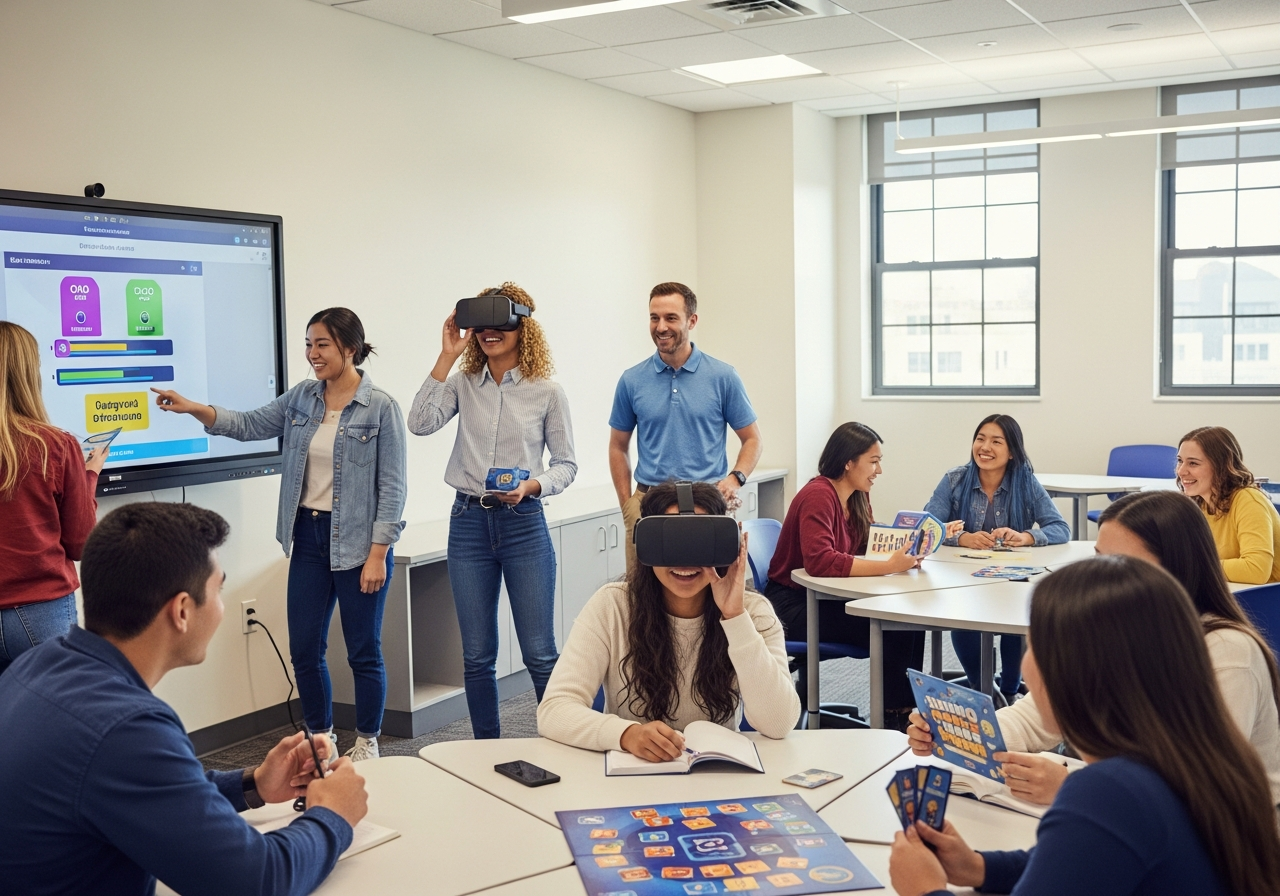
Virtual reality (VR) and augmented reality (AR) offer students the opportunity to concretize abstract concepts and explore distant places. These technologies enable students to become more involved in the learning process and better understand information.
Practical Example: A biology teacher uses VR to take her students inside the human body. Students watch the heartbeat, see the movement of blood cells, and closely examine how organs work. This makes biology lessons a more impressive and unforgettable experience.
Application Areas
VR and AR can be used in many areas, from history to science, art to engineering. With VR, students can visit ancient Rome; with AR, they can manipulate molecules in a 3D environment and conduct experiments in virtual laboratories.
Practical Example: A physics teacher uses AR applications to show her students the laws of gravity and motion. Students throw virtual objects into the air, observing how the objects move and the effect of gravity. This makes physics lessons more concrete and understandable.
Why Is It Important to Focus on the Skills of the Future?
21st Century Skills
As the labor market is reshaped by digitization and automation, educational institutions are beginning to focus on skills such as problem-solving, critical thinking, collaboration, and emotional intelligence. These skills are critical for students to succeed in future careers.
Practical Example: A teacher gives her students a project, asking them to work together to solve a problem. Students generate different ideas, listen to each other, share tasks, and ultimately propose a solution. In this way, students develop their collaboration and problem-solving skills.
Redesigning the Curriculum
Curricula are being redesigned to not only provide students with academic knowledge but also to equip them with skills such as creativity, adaptability, and entrepreneurship. Students will need these skills to be prepared for the challenges they will face in their future careers.
Practical Example: A teacher assigns students the task of preparing a business plan. Students develop a product or service idea, conduct market research, prepare financial projections, and prepare a presentation. In this way, students develop their entrepreneurial skills.
How Can Schools Lead the Way in Sustainability and Environmental Awareness?
Green School Concept
Sustainability is becoming increasingly important on the agenda of schools. By 2030, many schools are expected to transform into green campuses that run on renewable energy, use sustainable materials, and are conscious of waste management.
Practical Example: A school meets part of its electricity needs by installing solar panels. It also collects rainwater for garden irrigation and provides students with recycling education. In this way, the school demonstrates an environmentally conscious approach.
Sustainability in the Curriculum
Environmental awareness and climate change are becoming part of the curriculum. Students are encouraged to develop solutions to global sustainability issues and are made aware of the need to exhibit environmentally responsible behavior.
Practical Example: A teacher assigns students the task of researching the effects of climate change. Students gather information from various sources, prepare presentations, and propose solutions to combat climate change. In this way, students gain awareness of environmental issues.
How Can Inclusion and Well-being Be Increased in Education?
Equal Opportunities
Education aims to provide an environment where every student can realize their potential. Thanks to artificial intelligence, accessibility technologies, and inclusive content, students with disabilities are also offered the same opportunities.
Practical Example: A school uses specially designed books and materials for visually impaired students. It also employs teachers who know sign language for hearing-impaired students. In this way, the school supports the education of students with disabilities.
Mental Health and Well-being
In the classrooms of the future, more emphasis will be placed on mental health and well-being. Topics such as mindfulness exercises, stress management, and emotional intelligence development will become core components of the curriculum.
Practical Example: At the beginning of lessons, a teacher does a short meditation with her students. She also teaches students methods for coping with stress and is sensitive to their emotional needs. In this way, the teacher supports the mental health of her students.
How Will the Role of Teachers Transform From Information Providers to Facilitators?
Guidance and Mentoring
In the future, teachers will be less about conveying information to students and more about facilitating, guiding, and mentoring the learning process. Teachers will help students discover their interests and talents.
Practical Example: A teacher holds one-on-one meetings with her students to learn about their interests and career goals. She then provides students with advice on how to achieve these goals and recommends appropriate resources. In this way, the teacher guides students.
Technology Integration
Teachers will effectively use technology to make the learning process more interactive and personalized. Teachers will use different technologies to deliver content that suits students' learning styles.
Practical Example: A teacher prepares an interactive presentation for her students, capturing their attention and increasing their participation in the lesson. She also gives students online exercises to reinforce what they have learned. In this way, the teacher uses technology effectively.
Will the Concepts of Micro-Credentials and Lifelong Learning Become Widespread?
Continuous Improvement
As the world of work changes constantly, the need for lifelong learning and continuous skill development is increasing. Micro-credentials and certificate programs help individuals advance in their careers and acquire new skills.
Practical Example: A school organizes short-term training courses on various topics for its graduates. These training courses help graduates learn new technologies and become more successful in their careers.
Flexible Learning Paths
Micro-credentials and certificate programs offer individuals flexible learning pathways. Individuals can shape their careers by participating in different programs according to their interests and needs.
Practical Example: An individual participates in a micro-credential program in software development, gaining basic knowledge and skills in this field. Later, he uses this knowledge to start working in a software company.
How Should We Prepare for a Dynamic and Connected World?
Global Collaboration
Educational institutions should encourage students to develop solutions to global problems and support international collaboration. Students should communicate with people from different cultures and gain different perspectives.
Practical Example: A school sends its students to an international exchange program. Students receive education in a different country, get to know different cultures, and improve their foreign languages. In this way, students gain a global perspective.
Technology Literacy
Students need to not only use technology but also understand how technology works and the effects of technology on society. As technologically literate individuals, students will be more successful in their future careers.
Practical Example: A teacher gives her students coding lessons, increasing their interest in technology. She also provides students with information about the safe use of the internet and the effects of social media. In this way, students become technology literate.
Future education trends highlight the integration of technology into educational processes and the personalization of the learning experience. These trends will redefine the roles of educators and students, while contributing to making the education system more dynamic, inclusive, and sustainable.
EdTech Turkey Comment
These predictions show that the education system in Turkey will also undergo a transformation. Increased investments in educational technologies and the effective use of these technologies by teachers will play a critical role in shaping the future of education.