

















Educational Technologies: Transforming Learning Experiences
Explore how educational technologies, including AI, AR, and VR, are revolutionizing learning, making it more interactive, personalized, and accessible.
 Berkay Batallı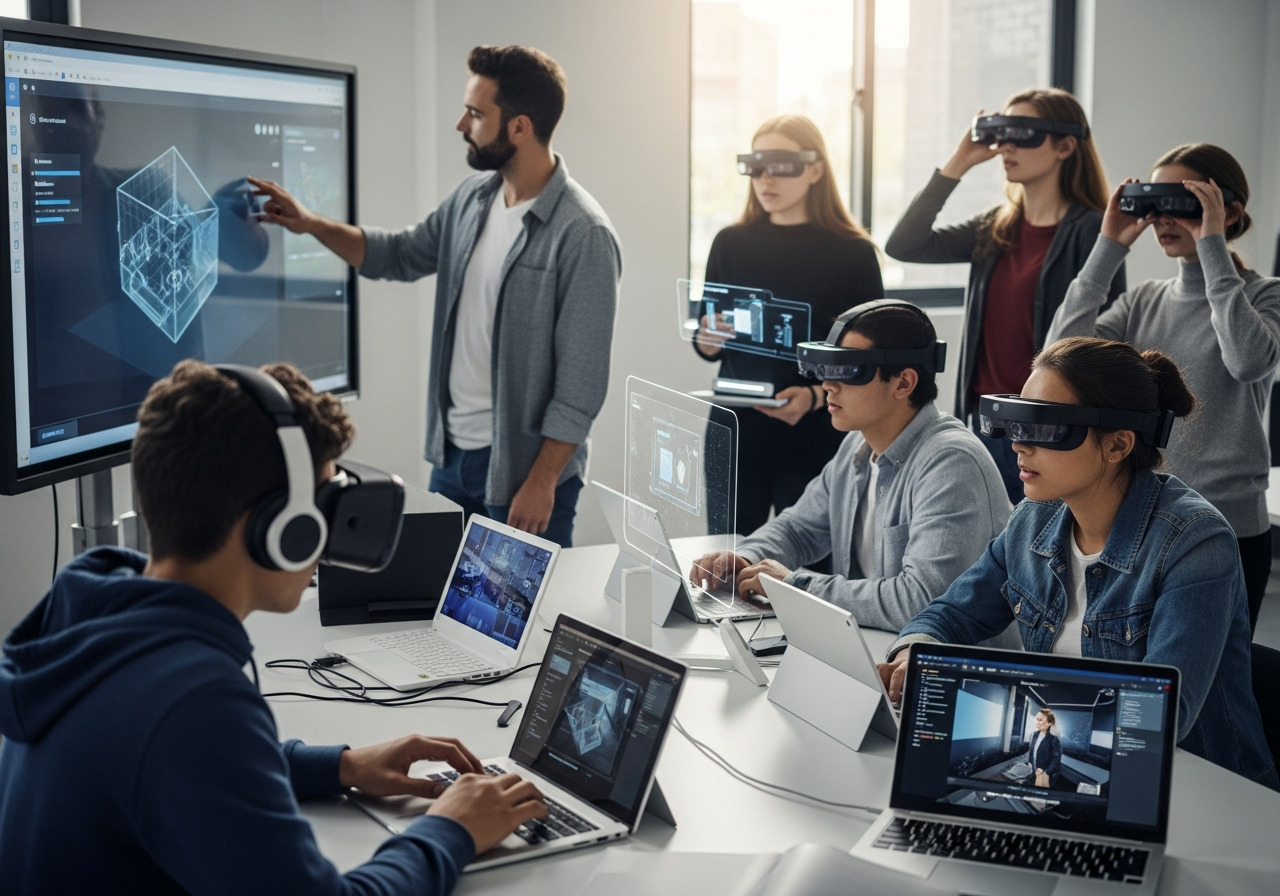
Rapid Advancements in Educational Technologies: Reshaping the Learning Experience
The impact of technology on education has increased exponentially in recent years. Moving beyond traditional classroom environments, educational technologies (EdTech) are making learning processes more interactive, personalized, and accessible, offering new opportunities for educators and students alike.
Integration of Digital Transformation into Learning Environments
Educational institutions are leveraging the opportunities offered by digital transformation to enrich learning environments. This includes:
- Smart Boards and Projection Devices: Making lesson content more visual and interactive, capturing students' attention, and supporting learning processes.
- Learning Management Systems (LMS): Facilitating students' access to course materials, tracking assignments, and strengthening teacher-student communication. Platforms like Moodle, Canvas, and Blackboard are widely used.
- Digital Libraries and Online Resources: Providing students with access to a vast pool of information, supporting research and learning processes. Platforms like JSTOR and Project Gutenberg offer valuable resources for academic research.
Artificial Intelligence and Personalized Learning
Artificial intelligence (AI) is revolutionizing the field of educational technologies. It personalizes learning processes, providing each student with an experience tailored to their needs.
AI-Powered Learning Platforms
AI algorithms analyze students' learning pace, interests, and areas of difficulty to provide personalized learning paths. These platforms enhance learning efficiency by providing students with custom content, exercises, and feedback.
Automated Assessment and Feedback
AI-powered systems can automatically evaluate students' homework and exams and provide instant feedback. This reduces teachers' workload while offering students faster and more personalized feedback.
Experiential Learning with Augmented Reality (AR) and Virtual Reality (VR)
AR and VR technologies make the learning experience more immersive and interactive, helping students concretize abstract concepts.
Virtual Laboratories and Simulations
AR and VR allow students to conduct experiments and explore complex systems in a safe and controlled environment. Virtual laboratories, especially in fields like science, engineering, and medicine, ensure that theoretical knowledge is supported by practical applications.
Virtual Tours and Cultural Experiences
AR and VR increase students' cultural awareness by taking them to historical sites, museums, and natural beauties around the world. Students can virtually visit ancient Rome or explore the Amazon rainforest.
Gamification and Motivation
Gamification makes learning processes more enjoyable and engaging, increasing student motivation.
Points, Badges, and Leaderboards
Gamification elements encourage students to track their achievements and strive harder in a competitive environment. Points, badges, and leaderboards increase student motivation, ensuring more active participation in learning processes.
Educational Games
Educational games that combine learning content with game mechanics help students assimilate information more effectively.